
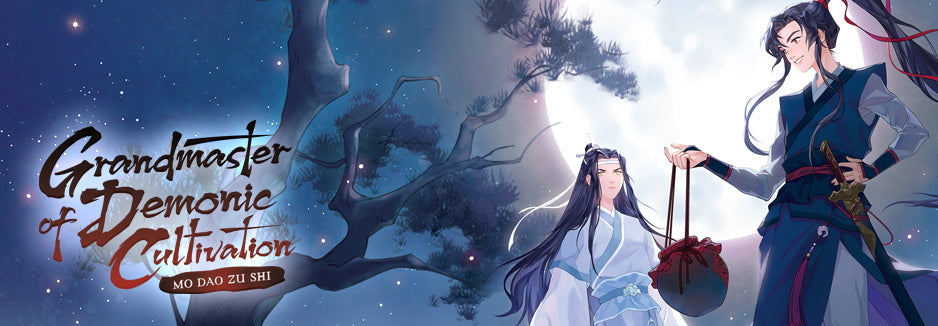
Grandmaster of Demonic Cultivation begins with a dead man returning to a world that remembers him as a villain. Wei Wuxian was once celebrated as a brilliant young cultivator, feared after he developed an unorthodox form of power, and finally condemned by the society around him. Years later, he awakens in another person's body and is drawn into a mystery that connects present crimes with the choices, losses, and lies of his first life.
That premise makes Grandmaster of Demonic Cultivation sound like a supernatural revenge story. It is partly that, but it is also a murder mystery, a historical fantasy, a moral argument about reputation, and a romance built through memory. For new readers, the easiest way into MDZS is to understand that the story is not asking only who committed a crime. It is asking who gets to decide what kind of person someone was.
Fans exploring the visual world around the series can browse Oriloot's Mo Dao Zu Shi collection, while this spoiler-light guide focuses on the work itself.

What is Grandmaster of Demonic Cultivation?
Grandmaster of Demonic Cultivation is the official English title of Mo Xiang Tong Xiu's Chinese danmei novel Mo Dao Zu Shi, often shortened to MDZS. It combines cultivation fantasy, political conflict, mystery, horror, humor, and a central love story between Wei Wuxian and Lan Wangji.
The official English novel edition from Seven Seas Entertainment runs for five volumes. The story has also inspired a manhua, a donghua adaptation, audio drama versions, and the live-action series The Untamed. Those versions share major characters and events, but they are not interchangeable scene for scene.
The novel opens after Wei Wuxian's death. Mo Xuanyu, an abused young man, uses a forbidden ritual to summon Wei Wuxian's soul into his own body. The resurrection gives Wei Wuxian a second life, but it also gives him unfinished obligations. A violent mystery soon places him beside Lan Wangji, the disciplined cultivator whose history with him is much deeper than outsiders understand.
Why the story moves between present and past
One of the most important things for a beginner to know is that Grandmaster of Demonic Cultivation is deliberately nonlinear. The present-day investigation keeps opening doors into the past. Instead of giving readers a simple biography, the novel first shows the reputation Wei Wuxian left behind, then gradually reveals the experiences that created it.
This structure turns memory into evidence. Public stories say Wei Wuxian became arrogant, dangerous, and evil. Personal memories show loyalty, improvisation, fear, sacrifice, and the consequences of war. The tension between those accounts drives the novel. Readers repeatedly have to ask whether a popular version of events is true, convenient, or useful to the people in power.
That is why even gentle fandom imagery, such as the paired figures in the Gusu Dreams plush series, carries emotional weight. The calm image of two characters together exists against a story shaped by separation, silence, and delayed understanding.
Wei Wuxian is not a simple misunderstood hero
It would be too easy to summarize Grandmaster of Demonic Cultivation by saying that society was wrong and Wei Wuxian was always right. The novel is more interesting than that. Wei Wuxian is intelligent, compassionate, reckless, proud, funny, secretive, and capable of making decisions that isolate him from people who might have helped.
His unorthodox cultivation becomes frightening partly because it changes the balance of power. Yet the story also asks whether conventional righteousness deserves trust when respected institutions protect status, hide wrongdoing, or abandon vulnerable people. Wei Wuxian's path exposes contradictions that were already present.
This moral uncertainty is one reason MDZS stays compelling after the mystery is solved. The story is not divided neatly between good sects and evil outsiders. It shows how fear can become consensus, how consensus becomes history, and how history can erase the motives of the dead.

Why Wei Wuxian and Lan Wangji work so well together
The romance at the center of Grandmaster of Demonic Cultivation grows through contrast. Wei Wuxian is expressive, improvisational, and willing to challenge rules. Lan Wangji appears controlled, formal, and deeply shaped by discipline. A weaker story would leave them as opposites. MDZS instead reveals how carefully each has watched the other.
Lan Wangji's devotion is powerful because it develops through action rather than public performance. Wei Wuxian's understanding arrives more slowly because he has spent much of his life turning pain into jokes and treating his own needs as less urgent than everyone else's. Their relationship becomes a form of recognition: each sees something in the other that reputation cannot explain.
The popular rabbit imagery associated with the pair appears throughout fandom collections, including Oriloot's Tu Rong Rong rabbit plush series. It works because MDZS constantly balances softness with danger. Small moments of care become meaningful in a world where direct speech often fails.
Is MDZS difficult for new readers?
The beginning can feel dense. There are courtesy names, birth names, titles, clans, locations, cultivation terms, and a timeline that moves backward. New readers should not try to memorize everything immediately. Focus first on Wei Wuxian, Lan Wangji, the present mystery, and the major clan relationships. The context becomes clearer through repetition.
The novel is the best starting point for readers who want the complete romance and narrative structure. The donghua offers fast visual immersion but condenses material. The Untamed is emotionally accessible and enormously influential, yet it changes plot elements and presents the central relationship under live-action adaptation constraints. There is no wrong entry point, but the official novel is the clearest reference for the original story.
Why Grandmaster of Demonic Cultivation still matters
Grandmaster of Demonic Cultivation endures because its fantasy mystery is built around recognizable human failures: the need to belong, the fear of social punishment, the convenience of blaming one person, and the damage caused by saying the right thing too late. Resurrection gives Wei Wuxian another life, but it does not erase what happened. The past has to be reinterpreted before it can be survived.
That mixture of grief and second chances explains why fans remain attached to objects that preserve the characters together, from the MDZS roly-poly mascots to the more delicate Wei Wuxian and Lan Wangji leaf artwork. They point back to the same emotional promise as the story: after distortion, separation, and death, recognition is still possible.
For a very different branch of danmei—one built around apocalyptic science fiction, biological horror, and moral judgment—continue with our spoiler-light essay on why Little Mushroom is more than a post-apocalyptic romance.
FAQ
Are Mo Dao Zu Shi and Grandmaster of Demonic Cultivation the same?
Yes. Mo Dao Zu Shi is the romanized Chinese title, MDZS is the common abbreviation, and Grandmaster of Demonic Cultivation is the official English title.
Is MDZS a romance?
Yes. It is a danmei romance between Wei Wuxian and Lan Wangji, combined with cultivation fantasy, political conflict, horror, and mystery.
Should beginners read the novel or watch an adaptation first?
Readers who want the complete original narrative should start with the official novel. Viewers who prefer a visual introduction can begin with the donghua or The Untamed, then return to the novel for the full story.


Share:
How the Lord of Mysteries MMO Turns Pathways Into Gameplay
Why Little Mushroom Is More Than a Post-Apocalyptic Danmei