
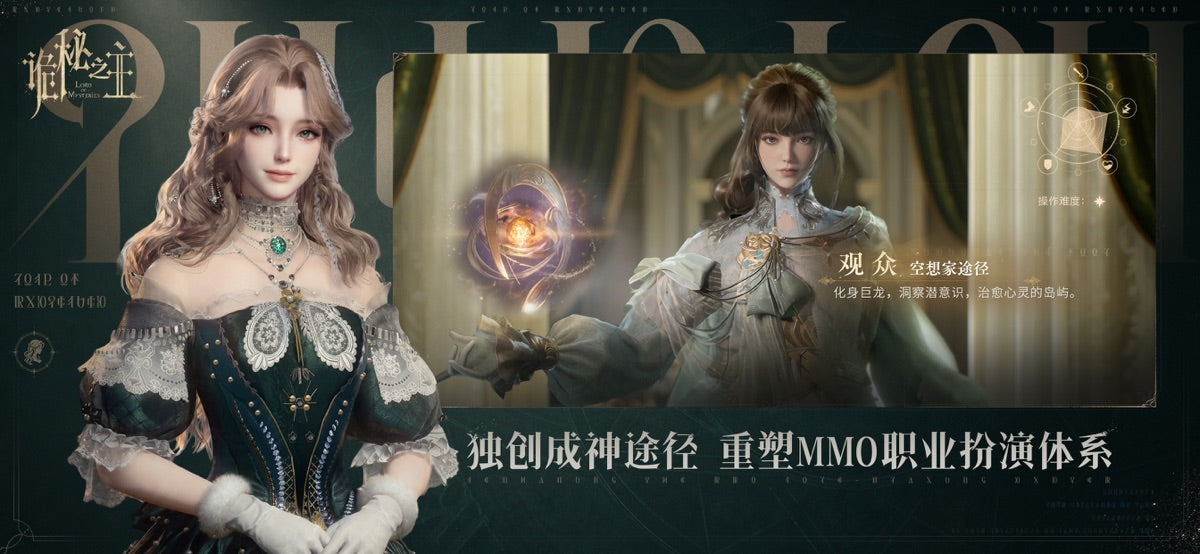
The central challenge for any Lord of Mysteries MMO is not recreating a foggy Victorian city. It is translating the novel's unusual idea of power into gameplay. In this world, becoming stronger is never just a matter of gaining experience points. A Beyonder chooses a Pathway, drinks potions, performs a role, digests supernatural power, and risks losing control. The system is part class design, part psychology, and part cosmic horror.
The Chinese public-beta version, launched on August 21, 2026, makes those ideas the language of its progression. The official description promises Pathways instead of conventional schools or professions, Sequences instead of ordinary levels, and the Acting Method instead of simple grinding. That is the right foundation for a Lord of Mysteries MMO, but the quality of the adaptation depends on whether those terms create meaningful choices rather than functioning as renamed MMO menus.
For confirmed launch dates, platforms, PC requirements, and global-release status, start with our Lord of Mysteries game China launch guide. Readers who want a physical overview of the series' symbolic language can also browse Oriloot's Lord of the Mysteries collection, while the analysis below focuses on the game systems themselves.

Why Pathways are more than MMO classes
Most MMORPG classes answer a practical question: what do you do in combat? A tank absorbs damage, a healer restores health, and a damage dealer defeats enemies. Pathways in Lord of Mysteries answer a larger question: what kind of person must you become to hold a particular form of power?
The official TapTap description presents 22 divine Pathways, each extending through ten Sequences from Sequence 9 to Sequence 0. Their fantasy is not limited to combat animations. The Seer route evokes divination, preparation, deception, and control. Other routes imply observation, knowledge, war, ritual, or transformation. A successful Lord of Mysteries MMO must therefore give each Pathway a different relationship with the world, not only a different skill rotation.
This is why character selection matters so much. Choosing a Pathway should affect exploration, social roles, puzzle-solving, risk, and narrative identity. The imagery behind that choice already resonates with fans through items such as the Pathways of the Divinities Fool series, where a Pathway is treated as an identity rather than a generic job icon.
Potions turn leveling into a dangerous ritual
In a conventional MMO, reaching the next level is usually automatic once a bar fills. The Lord of Mysteries MMO has a better narrative tool: the potion. Advancement can be framed as preparation, acquisition, ritual, and consequence. A player should understand what they are consuming and why the next Sequence changes them.
The official game materials describe collecting materials, using potions, digesting them, and advancing through Sequences. This creates the possibility of a progression loop that feels closer to the novel. Instead of treating power as a reward with no emotional cost, the game can make every promotion feel like an agreement: the player receives new abilities while accepting a new burden.
Tarot symbolism helps make that structure legible. The official Tarot Fugue collection shows how character, symbol, and role can be joined in one visual system. The game has the same opportunity. A Sequence should be memorable because its name, behavior, powers, and risks point in the same direction.
How the Acting Method can change ordinary quests
The Acting Method is the most promising idea in the adaptation. In the novel, a Beyonder does not digest a potion by mindlessly repeating attacks. They understand and perform the principles of their Sequence without forgetting that performance is not the whole self. That distinction gives the famous warning—remember that you are only acting—its force.
In gameplay, this can transform routine quests. A Seer may need to interpret signs, prepare before danger, or guide another character without claiming certainty. A Spectator may learn through observation and social reading. An Apprentice may solve movement and boundary problems. If acting becomes a set of role-specific choices, the Lord of Mysteries MMO can make progression feel personal.
If acting is reduced to a daily checklist, however, the system loses its point. The best version would reward understanding, variation, and consequences. It would also preserve the tension between adopting a role and being consumed by it.

Sanity gives failure a meaning beyond defeat
The official description also emphasizes sanity and loss of control. That is essential. Cosmic horror becomes shallow when madness is only a colored status bar. In Lord of Mysteries, dangerous knowledge, corrupted environments, supernatural contact, and reckless advancement all threaten the integrity of the self.
A strong sanity system should influence perception, decision-making, group trust, and the cost of using power. It should make players ask whether an ability is worth using now. The Lord of Mysteries MMO does not need to punish players constantly, but it does need to make power feel conditional.
That balance is also reflected in Klein's familiar objects. His yellow crystal pendulum represents careful divination rather than uncontrolled force. The appeal of the setting comes from preparation, symbolism, and restraint as much as spectacle.
Why a dual story is the right narrative choice
The developer says the game combines an original-novel storyline with a separate player storyline. This is a sensible solution. Fans want to encounter Tingen, the Nighthawks, the Tarot Club, and characters they remember, but an MMO also needs to allow thousands of players to feel that their choices matter.
A player-created Beyonder can stand near Klein's history without replacing him. The game can revisit known events as shared memory while using new investigations, regions, and social conflicts for the player's own arc. The Lord of Mysteries MMO becomes most convincing when it treats the novel as history with weight, not as a sequence of cameos.

What will determine whether the adaptation succeeds?
The technology is easy to advertise. UE5 environments, large battles, character customization, and a big world all look impressive in promotional material. The harder test is whether the game's systems preserve the novel's logic.
Players should watch for four things: whether Pathways change more than combat; whether acting requires understanding; whether sanity creates meaningful decisions; and whether the story respects the difference between Klein's legend and the player's life. Even a beautifully rendered Backlund will feel generic if every Pathway eventually becomes the same daily grind.
The series' desk and ritual aesthetics can be seen in the official The Fool mechanical keyboard, but the true promise of the game is not visual branding. It is the chance to make players inhabit a system where identity, knowledge, and power are inseparable.
Final thoughts
The Lord of Mysteries MMO has chosen the correct concepts to adapt: Pathways, Sequences, potions, acting, digestion, sanity, exploration, and dual narrative. Those systems give it a chance to be more than a familiar MMO wearing occult clothing.
The next question is execution. If progression makes players think like their Pathway while guarding their humanity, the adaptation can capture something rare. If not, the vocabulary will remain faithful while the experience feels ordinary. That tension is exactly why the Chinese public beta is worth watching closely.



Share:
Why Heaven Official's Blessing Is So Loved: A Beginner-Friendly Guide to TGCF
What Is Grandmaster of Demonic Cultivation About? A Beginner's Guide to MDZS