
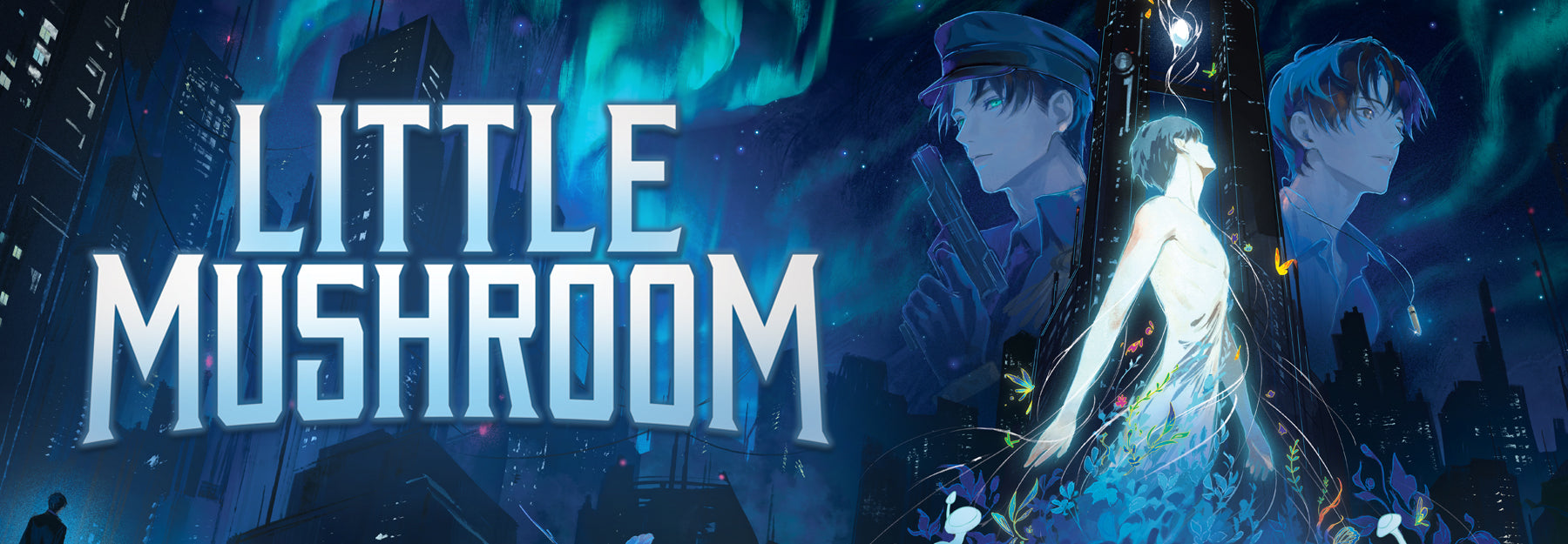
Little Mushroom sounds gentle, almost whimsical. Its world is anything but. Humanity survives inside fortified bases after cosmic radiation has transformed the planet's living systems. Outside those walls, mutation is constant. Inside them, survival depends on identifying and killing anything judged nonhuman. Into that world walks An Zhe, a sentient mushroom wearing a human form and searching for the spore that was taken from him.
This is the central tension of the Little Mushroom danmei novel by Yi Shi Si Zhou: the character who appears least human may understand tenderness better than the society determined to destroy him. The story combines post-apocalyptic science fiction, body horror, philosophical uncertainty, and a slow romance between An Zhe and Lu Feng, the feared Judge responsible for detecting infected outsiders.
Readers can browse Oriloot's Little Mushroom collection for visual interpretations of the novel, while this spoiler-light essay focuses on why the work reaches far beyond its deceptively cute title.

What is the Little Mushroom danmei about?
Little Mushroom begins in the Abyss, an ecosystem filled with mutated life. A small sentient mushroom absorbs the remains and memories of a dead human named An Ze, takes on a similar form, and becomes An Zhe. His purpose is simple: recover his missing spore. To do that, he must enter the Northern Base and pass as human.
The danger is immediate because the Base cannot afford uncertainty. Parasitic and mutated organisms can imitate human beings, so Judges inspect returning travelers and execute those believed to be infected. Lu Feng is the most feared of them. His decisions protect thousands, but each decision also rests on an impossible question: can anyone identify humanity with perfect accuracy?
An Zhe is therefore both vulnerable and disruptive. He does not enter the Base to defeat it or expose its hypocrisy. He observes. His quiet attention reveals how fear organizes daily life, how institutions turn emergency measures into moral rules, and how people remain capable of kindness inside a system built around suspicion.
Why the apocalypse feels different
Many post-apocalyptic stories treat the end of the world as permission for constant action. Little Mushroom uses catastrophe to ask what a species is willing to become in order to continue. The Northern Base is not simply cruel. Its violence has a rational foundation: one mistake can destroy the remaining human population. That makes its choices more disturbing, not less.
The novel's science-fiction imagery reinforces that pressure. Radiation, genetic change, altered ecosystems, spores, and biological boundaries make identity physically unstable. Human beings want a clean line between themselves and the organisms outside. An Zhe's existence proves that the line is not clean.
The visual contrast between beauty and danger appears in collections such as the Firefly Edition Fire Forest cards. Luminous forests and delicate organisms are not merely decorative. They express the novel's unsettling idea that transformation can be beautiful even when it threatens human survival.
An Zhe is not human, but the story is deeply humane
An Zhe's perspective gives Little Mushroom its unusual emotional tone. He understands many human memories and behaviors, but he does not automatically share every human instinct. He can be direct where people are defensive, curious where they are disgusted, and gentle where institutions expect fear.
Through him, ordinary habits become strange again: ownership, shame, sacrifice, loneliness, and the desire to be recognized by another person. An Zhe learns humanity without simply becoming a conventional human.
That idea is reflected in the recurring attraction of small personal objects. The Little Mushroom couple ring and necklace echo the story's interest in connection that survives unstable bodies and categories. The meaning comes from recognition, not from a biological definition.

Why An Zhe and Lu Feng are such a powerful pairing
The relationship in Little Mushroom is compelling because it begins with an ethical contradiction. Lu Feng's role requires him to eliminate nonhuman threats. An Zhe is precisely the kind of being that role exists to destroy. Their closeness cannot grow by ignoring the danger; it grows because each is forced to see what the other's existence means.
Lu Feng is often described as cold, but his restraint carries the burden of decisions that cannot be made safely. An Zhe appears soft, but his quiet persistence is a form of courage. The romance develops through observation, protection, doubt, and a gradual breakdown of certainty.
This is not a story where love magically solves the apocalypse. Love matters because it changes how the characters understand responsibility. To care for one individual can complicate every rule designed for the survival of the many.
Little Mushroom asks who has the right to judge
Judgment is the novel's central moral structure. The Base judges bodies. Lu Feng judges suspected infection. Readers judge the institutions that keep humanity alive. Yet Little Mushroom repeatedly removes the comfort of complete information.
A decision can be necessary and still be tragic. A system can protect life and still destroy innocent people. A nonhuman being can carry memories, attachment, and moral attention. The story becomes powerful because it refuses to reduce these tensions to a slogan.
The Travel Diary acrylic series captures the quieter side of that argument: identity is also built from places visited, people remembered, and moments carried forward. Survival is not only biological continuation.
Why 2026 is a good time to start the English edition
Seven Seas Entertainment has released a new official English translation with new illustrations in a two-volume deluxe hardcover edition. Volume 1 arrived on August 4, 2026, and Volume 2 is scheduled for November 17, 2026. Each volume includes a dust jacket, printed edges, and additional cover artwork.
That release gives new readers a clear legal edition and creates a useful moment to discuss the novel as science fiction, not only as a romance label. Little Mushroom will appeal to readers who enjoy biological horror, moral dilemmas, quiet protagonists, slow emotional development, and stories where the fate of a species is inseparable from one intimate relationship.
Final thoughts
Little Mushroom is more than post-apocalyptic danmei because every part of its romance is connected to its science-fiction question. An Zhe and Lu Feng cannot understand one another without confronting species, infection, judgment, duty, and the limits of certainty.
The novel's most lasting idea is not that humanity is secretly evil or that nonhuman life is automatically pure. It is that being human may be less about belonging to the correct category than about how one responds to another life under impossible conditions.
Readers who remain drawn to the story's mixture of fragile beauty and catastrophe can also explore the Little Mushroom Rose Garden collection, where that same contrast becomes visual rather than explanatory.
Readers who want to explore another major danmei tradition can also begin with our spoiler-light beginner's guide to Grandmaster of Demonic Cultivation, which approaches romance through cultivation fantasy, mystery, and political conflict.
FAQ
Is Little Mushroom a danmei romance?
Yes. It is a danmei romance centered on An Zhe and Lu Feng, set within a post-apocalyptic science-fiction story.
Is Little Mushroom horror?
It contains body horror, mutation, death, and existential danger, but its tone also includes tenderness, philosophical reflection, and quiet humor.
How many volumes are in the new English edition?
The Seven Seas deluxe English edition has two volumes. Volume 1 was released on August 4, 2026, and Volume 2 is scheduled for November 17, 2026.


Share:
What Is Grandmaster of Demonic Cultivation About? A Beginner's Guide to MDZS